 FR
FR DE
DE IT
ITMonlam Festival Tours in Amdo in 2009 |
||
| | 2009 | 2010 | 2011 | 2012 | | ||
Brief info: |
||
Monlam
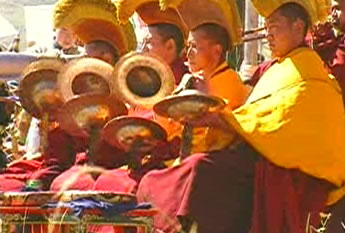
Festival, also called the Great Prayer Festival is the grandest
religious festival in Tibet during the spring Festival. It
has its origin in a prayer meeting organized at Jokhang Temple
by Tsong Khapa, founder of the Gelukpa Sect, in 1409. Thousands
of monks from far and near will gather for prayers, theological
debates and examination for Geshe, a doctoral degree in Buddhist
theology at monasteries and pilgrims will come to listen to
sermons. This tour of Monlam Festival will provide us a chance to join colorfully dressed pilgrims and monks in a variety
of religious ceremonies at Tibetan monasteries in Amdo. The
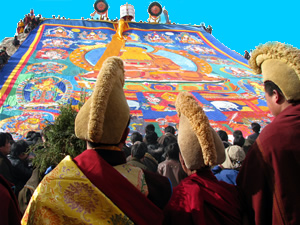
highlight of the festival will be the'sunning of the Buddha'
ceremony, during which a thangka of Buddha measuring 90 ft
of length and 60 ft of width will be unfurled on a hillside.
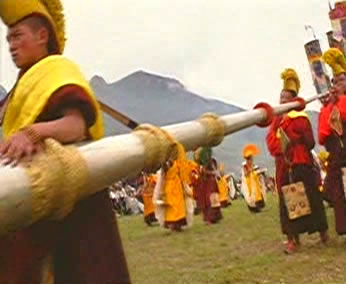
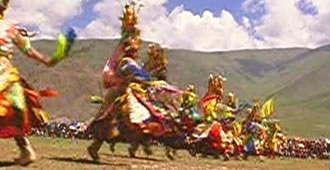
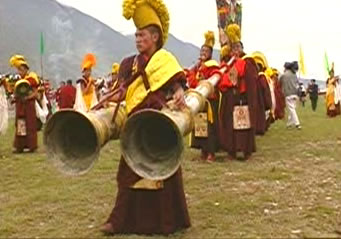
The festival will be accompanied by lively Cham dances and
prayer assemblies throughout the entire period of two weeks. |
||
Itinerary: |
||
Jan
31 arrive in Beijing |
||
Some Highlights |
||
1.Labrang Monastery: 280 km to the southwest of Lanzhou, Labrang Monastery is the second largest of China's six great lamaseries practicing the Yellow Sect (Gelukpa) of Tibetan Buddhism. The monastery has more than 2,000 monks in residence and six academic institutes, as well as important Buddhist cultural relics and 10,000 books of Tibetan scripture. 2.Kumbum Monastery: Kumbum Monastery located in Rushar Township, it was founded to commemorate the birthplace of Tsongkhapa(founder of the Gelukpa school of Tibetan Buddhism). It is also one of the six great lamaseries practicing the Yellow Sect (Gelukpa) of Tibetan Buddhism. 3. Rongpo Gonchen Monastery: Located in Repkong county, Huangnan Prefecture, Ropong Gonchen is the biggest Gelukpa Monastery in south Qinghai. It is the principal monastery of Repkong and was originally constructed in 1301. There are many branch monasteries of Rongpo Gonchen, among them are Nyentok Monastery, Gomar Monastery and Wutun Monasteries(Sengeshong Yagotsang and Sangeshong Magotsang) Meeting starting on 1st Jan, 4.Wutun Monasteries Located in Wutun Village, Repkong County, Wutun Monasterys(Sengeshong Yagotsang and Sengeshong Magotsang) are famous for Tibetan painting (Tangkha). There are many fine art works gathered in the monastery like frescos, obliqued embroideries. 5.Gomar Monastery Gomar Monastery is located in Gomar village in Repkong, With the height of 30 m and 1,156 sq. m wide, it has magnificent architecture. Gomar Stupa is supposed to be built in 1741. It has 72monks in the present time and most of them are from Gomar village. 6. Nyentok Monastery Located at Nyentok Village(1 km north to the town of Repkong).It was built in 1684. There are 35 monks at present time and most of them are from Nyentok Village. |
||
Detailed Itinerary: |
||
Jan
31 arrive in Beijing Welcome to Beijing, capital of China. Being one of the biggest cities in the world, Beijing had just celebrated its 850th anniversary of being the Chinese capital. From the imperial Forbidden City to the Great Wall of China, from the Hutong alleys to the wide and straight Chang’an Avenue and from the courtyard houses to modern skyscrapers, Beijing has a great deal to offer for us to explore its dynamic culture, tradition and heritage. Meet by professional English speaking guide from Trans Tibet Tours at the airport and transfer to hotel for check-in. In the evening we will have welcoming dinner to acquaint ourselves and to brief the upcoming events scheduled on this trip. Feb.
01 Beijing/Xining Fly to Xining,
the capital city of Northwest China's Qinghai province. Xining is the capital of Amdo area of Tibet and is literally translated
Western Peace, a projection of wish fulfillment by imperial
order. It has long been on the fringes of the western Chinese
empire, probably established around the Han Dynasty (206 BC-220
AD), and it remained an important trading post in the area,
mainly for goods to and from Tibet and China. It was not until
1928 that the city, with the formal establishment of Qinghai
as a province, was to become the official capital. Visit the
Kumbum Monastery upon arrival. The Kumbum Monastery built
in1560 AD is one of the six most famous Tibetan Buddhist Monasteries.
Kumbum in Tibetan means a grand place housing 100,000 Buddha.
The sight Feb. 02 Xining/Tongren via Youning Gonpa Drive for 125
miles to Tongren via Youning Gonpa. Tongreng is named Repkong
in Tibetan. In the 15-16 century, the Tibetan Buddhism of
Gelukpa Sect (Yellow Sect) came into Tongren area. Painting,
sculptures and stone inscription for Buddhism are sprang up
by Tibeta Feb. 03 Tongren (Full day visit Gomar Gonpa, Sunning the Buddha) We are going to experience a fantastic view of perhaps the biggest breakfast in the world this morning. Local Tibetans bring their milk tea and breakfast in the monastery and talk about their stories happened last year and exchange their ambition for the coming year. Today's highlight is the grand ceremony of Sunning the Buddha at the Gomar Gonpa Monastery in the afternoon. Tibetans traditionally place a huge painting or embroidery of the Buddha Tangka on the slope of a hill to share the benefit of Buddhism with all the creature in the air which we could not see they are existed. BLD. Feb. 04 Tongren (Full day visit Wutun Monastery, Cham Dance) The Wutun Monastery is famous throughout Tibet for its beautiful artwork of Buddhist art of Thangka. Monks are trained at a very young age to carry on this tradition from generation to generation. We will meet some of the outstanding Thangka painters and exchange views on this special art form with them in this monastery. Over many centuries, Tibetan Buddhists evolved an art form to open passages from the ordinary world to the extraordinary realm of pure wisdom and compassion. Known as "thangka" paintings, this unusual art form is a vehicle of transition from the mundane world to sacred reality. Thangkas are intended to nurture humankind's path toward enlightenment. The meditation deities shown embody a particular aspect of the fully evolved, enlightened mind. The themes of thangka iconography are fixed by tradition and are based on principles of expression, proportion and detail. Commissioning the painting of a thangka and the painting process itself are considered highly meritorious actions. The material used for thangkas is linen cloth or cotton fabric; silk cloth is reserved for important subjects. Before painting begins, the material is stitched along the edges with flax thread and stretched on a specially made wooden frame (T. Tang-shin). Then a paste made of animal glue mixed with talcum powder is spread over its surface to block up the holes in it. When the paste is scraped off and the cloth gets thoroughly dried, the material is ready for painting. To begin, the artist works out the sketches of the images with charcoal sticks. The drawing usually begins with the figure in the centre and then goes to the surrounding deities or landscape. Coloring comes last. The pigments used come from non-transparent minerals and plants such as malachite and cinnabar. They are mixed with animal glue and ox bile to make the lustre stay. When the painting is done, it is mounted on a brocaded silk border. Important thangkas are embroidered on transferred outlines; some of them use a great variety of stitch patterns such as flat and piled stitches to give them a three-dimensional effect. Feb. 05 Tongren (full day visit to Gomar Monastery, Cham Dance) Gomar in Tibetan means red gate. Apparently all gates of Gomar Monastery are in red. Actually the gates of nearby Tibetan village are all in red as well because this village used to be very wealthy and they could afford to decorate their gates with red copper in the old days. Today we will join local Tibetans for their Cham Dance. The Cham dance calls on traditions that date back more than 500 years. The fourth Panchen Lama went to Shambala through meditation and created the Cham Dance according to the cham dance in Shambala and the fifth Dalai Lama formalized the dances in the Cham Yig book, and each monastery has created its own unique interpretations over the centuries. Cham performances and ceremonies feature sacred masked dances, sacred music, healing chants and spectacular richly ornamented multi-colored costumes. The dancers use symbolic hand gestures known as madras to transmit healing powers from the deities. With accompanying narration and a monastic debate demonstration, the program provides a fascinating and warm glimpse into ancient and current Tibetan culture. BLD. Feb. 06 Tongren/Xiahe In the afternoon we will drive to Xiahe which exists due to the Labrang Monastery which is one of the six main Tibetan monasteries of the Gelupka sect. Xiahe is the largest Tibetan monastery town outside Lhasa. We will be enchanted by the atmosphere of this town which is a mixture of Tibetan, Muslim Hui and Han Chinese, particularly during the festive season when the usually silent streets are crowded with pilgrims and Tibetan monks in their saffron robes. BLD Feb. 07 Xiahe (Labrang Monastery) The highlight of Monlam Festival is the Sunning the Buddha. We will join a large crowd of Buddhists who have been waiting since the early morning for today's special event, the annual 'sunning of the Buddha' ceremony. In the morning, a large yelp will Febk the entrance of a horse-ridden lama clutching an iron stick, followed by the entry of the thangka of the Buddha. The 98 by 66 ft thangka will be carried out of the hall towards a mountain range to be spread along the slope of the Nan Mountain. Along the way, crowds of worshippers will gather around to touch the thangka in order to get the New Year blessing, and later sing, dance and hold prayer sessions to celebrate the occasion. BLD. Feb. 08 Xiahe (Labrang Monastery) Today we will take part in Cham Dance, a lively ceremony of religious dances, in the square adjacent to the Lection Hall of Labrang Monastery. Not only the dancers and musicians, but also the audience will be blessed through participating in this grand ceremony. Feb. 09 Xiahe (Labrang Monastery) Visit the monastery in the morning and free at leisure in the afternoon. After dinner we will visit an exhibition of yak butter sculptures, which have an almost surreal beauty when lit under the lamps. Visitors invariably touch the flower shelf with their foreheads to show their respect toward the Buddha. BLD. Feb. 10 Xiahe (Labrang Monastery)/Lanzhou via Linxia We will join the local Tibetans in the morning for their ritual ceremony of Turning the Buddha. A Buddha of 9-15 feet high made of silk will be carried by a group of monks to Kora the Labrang Monastery; of course large crowds will follow this ceremony again in order to get blessings. After lunch we will drive to Lanzhou, the capital city of Gansu province via the Muslim town of Linxia which is considered by Chinese Muslims as the Mecca of China. BLD. Feb. 11 Lanzhou/Beijing Fly to Beijing in the morning. After lunch we will start to explore this Chinese capital from its heart, the Tiananmen Square where you can feel the heartbeat of China. Bordered by the Great Hall of the People, Mao's Mausoleum and the National Museum of China, Tian'anmen Square has witnessed many of the historical events happened in China since 1911. We then walk to the Forbidden City, the complex of imperial palace, which were home to the Emperors for over 500 years. Grand halls and courts gradually give way to more intimate domestic quarters, giving an insight into the pampered isolation of the emperors. Tonight's dinner is the Peking duck. BLD. Feb12 Beijing Morning visit to the Great Wall of China, which was first built in the Warring States period (475-221BC) as a series of earthworks erected by individual kingdoms as a defense against each other as well as from invasions from the north. Stretching almost 4500 miles from the Baohai Sea to the sands of Central Asia, the Great Wall of China is crowned one of the wonders of the world. The present day wall was left from the Ming dynasty. After lunch we will visit the Summer Palace, the largest royal garden in the world. BLD. Feb. 13 Departure Transfer to the airport to board your flight back. |
||
Quotation |
||
USD
1980/person (1-3pas) What's
Included in Tour Prices: What's
Not Included in Tour Prices: |
||
| Go Back to Amdo index |
Copyright 2018 Trans Tibet Tours All right reserved